Many people leave a large group Pilates class feeling that they “did something,” yet struggle to explain what they learned. That reaction is not a personal failing. It reflects a structural problem: when one instructor faces roughly twenty bodies, the attention each person needs for precise movement is diluted to the point that the session becomes of limited use.
There is no randomised controlled trial that directly compares a twenty-person Reformer class with a five-person one. The argument below does not invent such a trial. It connects how peer-reviewed literature defines Pilates with established principles of motor learning, and then asks what those principles imply when class size approaches twenty.
What Pilates requires
Pilates is not a follow-along cardio format. A systematic review of academic definitions characterises it as a mind–body exercise method that emphasises strength, core stability, flexibility, muscle control, posture, and breathing.1 Historical and philosophical accounts of the method place precision and control at the centre of practice, not mere repetition of shapes.2
If the goal is control and precision, each repetition is a learning trial. Learning trials only improve skill when the performer receives enough information about their attempt: whether the pelvis tipped, whether the spring load matched their capacity, whether a compensation crept in. Without that information, practice can reinforce error as easily as it builds skill.
What motor learning needs
Motor-learning research treats augmented feedback (information about the outcome or quality of a movement that the performer would not otherwise have) as a primary variable in skill acquisition.3 The challenge-point framework of Guadagnoli and Lee goes further: learning depends on an optimal amount of interpretable information arising from performance. Too little information retards learning; so does too much.4
Feedback is not only informational. Reviews of factors that influence motor skill learning show that feedback also carries motivational properties that shape how well people learn and persist.5 A generic cue shouted to the room (“engage your core”) is not the same as knowledge of your performance. The former may create the feeling of instruction; the latter is what motor learning requires.
Honesty requires a nuance. Classic work on knowledge of results also warns that constant external feedback can act as guidance: performance looks better while the instructor is present, yet learning suffers when that guidance is withdrawn.3 The claim here is not that more talking is always better. It is that a twenty-person format typically supplies too little individual information (the opposite problem from over-guidance), and the challenge-point model predicts that under-information is suboptimal for learning.4
Why a class of about twenty fails that test
Consider the arithmetic of attention. One instructor, approximately twenty participants, and (especially on Reformer apparatus) springs, straps, footbars, and carriage positions that each demand visual monitoring. The minutes available for observing any single person collapse. Timely, individual knowledge of performance becomes rare. Compensations go uncorrected. The hour passes, but transferable skill does not accumulate in proportion to the sweat.
In that setting you cannot get the attention you need. The session may still offer social energy, music, or a sense of community. Those are real benefits. They are not substitutes for the feedback conditions that motor-learning theory associates with useful skill change.345
Who a large class still suits
A large group can remain appropriate when the primary aims are affordability, familiarity with basic movement, or social motivation, and when expectations are adjusted accordingly. It is a weaker choice when the aim is technique, rehabilitation of a specific pattern, safe progression on spring-loaded equipment, or measurable improvement in control: the qualities that define Pilates in the academic literature.12
Small-scale practice at PT 7
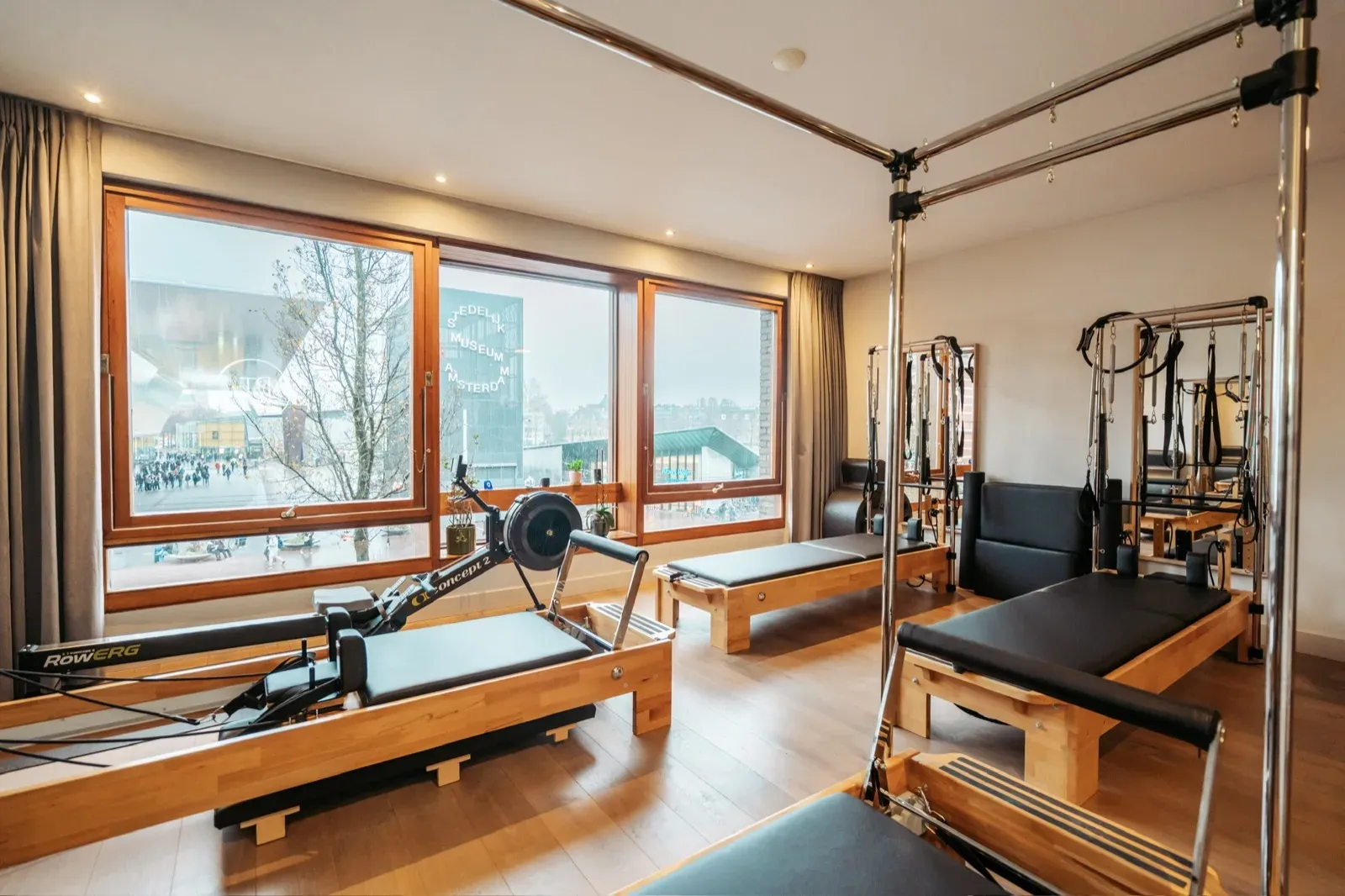
At PT 7 Amsterdam (Van Baerlestraat 76C, Museumplein), group sessions are capped at a maximum of five participants. That limit is intentional: it preserves enough observation time for individual correction, spring selection, and progression that matches each body. Private sessions remain available when even closer coaching is required.
Teams of roughly twenty people are not asked to train as one mega class. Corporate and group bookings are organised as waves of small groups in the studio, or as on-site mat sessions at the workplace. See our For Business page.
If you want Pilates that is useful for learning, not only for filling an hour, book a small-group or private session, or read more about Reformer Pilates at Museumplein.
References
- Wells, C., Kolt, G. S., & Bialocerkowski, A. (2012). Defining Pilates exercise: A systematic review. Complementary Therapies in Medicine, 20(4), 253–262. https://doi.org/10.1016/j.ctim.2012.02.005
- Latey, P. (2001). The Pilates method: History and philosophy. Journal of Bodywork and Movement Therapies, 5(4), 275–282. https://doi.org/10.1054/jbmt.2001.0237
- Salmoni, A. W., Schmidt, R. A., & Walter, C. B. (1984). Knowledge of results and motor learning: A review and critical reappraisal. Psychological Bulletin, 95(3), 355–386. https://doi.org/10.1037/0033-2909.95.3.355
- Guadagnoli, M. A., & Lee, T. D. (2004). Challenge point: A framework for conceptualizing the effects of various practice conditions in motor learning. Journal of Motor Behavior, 36(2), 212–224. https://doi.org/10.3200/JMBR.36.2.212-224
- Wulf, G., Shea, C., & Lewthwaite, R. (2010). Motor skill learning and performance: A review of influential factors. Medical Education, 44(1), 75–84. https://doi.org/10.1111/j.1365-2923.2009.03421.x